Pan-Fried Sausage Gnocchi
The best thing about pan-fried gnocchi is what happens once the bottoms start catching in the pan.
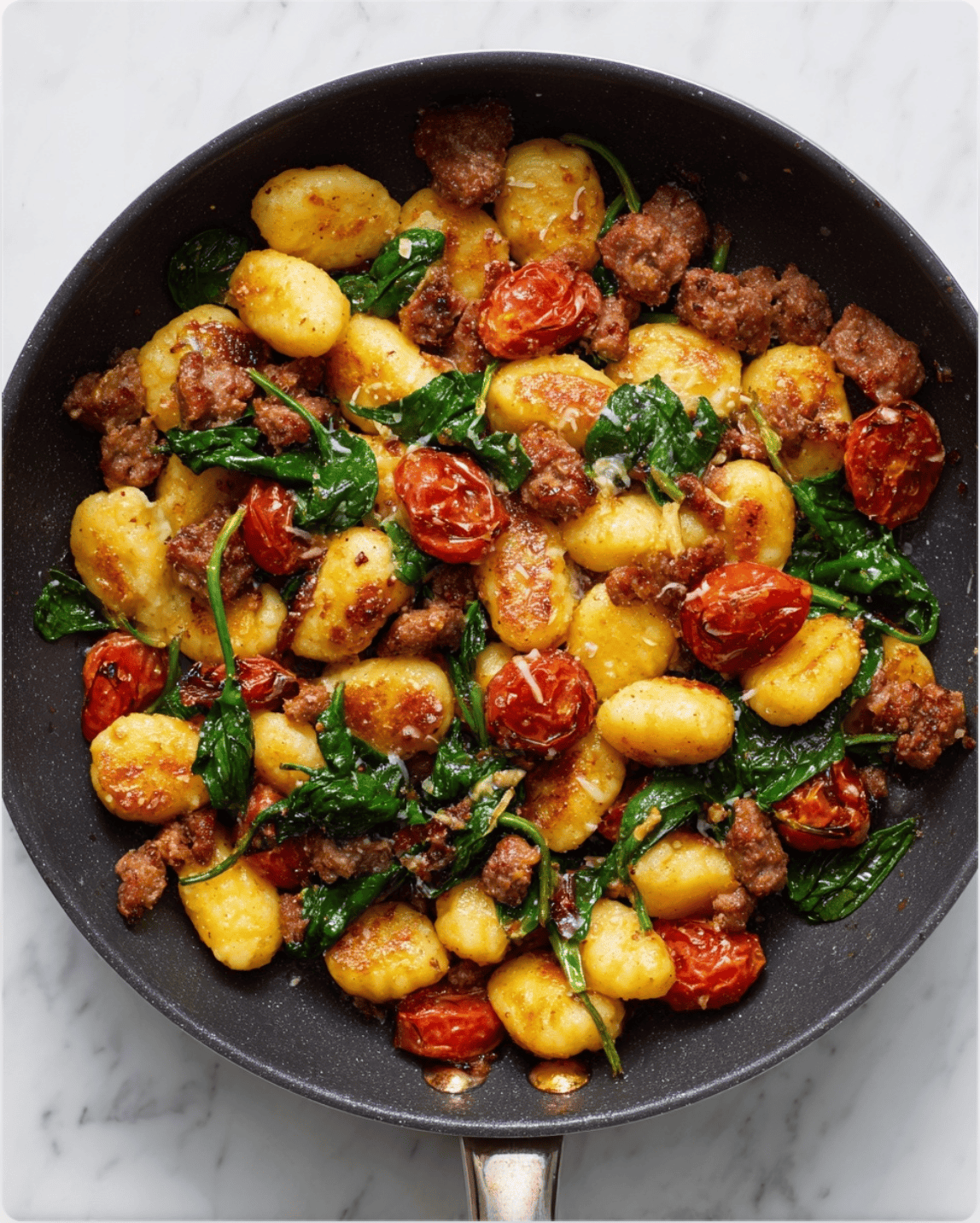
Add sausage, blistered tomatoes, spinach, and a little Parmesan, and you end up with a skillet that feels hearty without being buried under sauce.
There’s no boiling the gnocchi into softness here.
They go straight into the pan and stay there long enough to pick up those golden, almost crisp patches that make them so much better to eat.
The sausage breaks up around them, the tomatoes soften and burst, and the spinach gets folded in right at the end so it keeps a bit of life.
A little Parmesan melts into the hot pan and catches on the gnocchi and sausage in places, which is probably my favourite bit.
It’s a very simple skillet, but nothing in it tastes flat.
You get browned edges, juicy tomatoes, salty sausage, soft gnocchi centres, and enough greens to make the whole thing feel balanced without trying too hard.
Page Contents
ToggleWhy You’ll Love This Recipe
- The gnocchi gets properly golden instead of being soft all the way through.
- Italian sausage adds loads of flavour without needing a complicated sauce.
- The cherry tomatoes blister and turn sweet in the pan.
- Spinach makes the whole thing feel fresher without changing the cosy feel of the dish.
- Parmesan melts into the pan juices and gives everything a savoury finish.
- It all comes together in one skillet.
- It is filling enough for dinner without being ridiculously heavy.
Ingredients
This recipe serves about 4 people.
For the skillet
- 500g potato gnocchi
- 350g Italian sausage, casings removed
- 250g cherry tomatoes
- 3 large handfuls baby spinach
- 3 garlic cloves, finely chopped
- 2 tablespoons olive oil
- 1 tablespoon butter
- 50g finely grated Parmesan
- 1/2 teaspoon chilli flakes, optional
- 1/2 teaspoon dried oregano
- 1/2 teaspoon cracked black pepper
- Salt, to taste
To finish
- Extra Parmesan
- Extra cracked black pepper
- A small drizzle of olive oil, if needed
A Few Things Before You Start
Do not boil the gnocchi first.
That would defeat the whole point of this version.
Pan-frying it gives you those browned surfaces while the inside stays soft and fluffy.
The sausage needs to be broken into rough chunks rather than tiny crumbs.
You want actual browned pieces running through the skillet.
Cherry tomatoes work much better here than chopped regular tomatoes because they can blister without flooding the pan.
And the spinach needs almost no cooking time.
Once it wilts, stop.
That is enough.
Instructions
1. Brown the sausage
- Heat a large non-stick or cast-iron skillet over medium-high heat.
- Add 1 tablespoon of olive oil.
- Add the sausage meat in rough chunks.
- Leave it alone for a minute or two so the underside can brown.
- Break it up slightly with a wooden spoon.
- Cook for about 5 to 6 minutes, turning occasionally, until browned and cooked through.
- Transfer the sausage to a plate.
Try not to break it down too much.
Those uneven little sausage pieces get crispier around the edges and look much better in the finished skillet.
2. Pan-fry the gnocchi
- Add the remaining tablespoon of olive oil to the same pan.
- Add the gnocchi in one layer.
- Let it sit undisturbed for about 2 minutes.
- Turn and continue cooking for another 5 to 7 minutes.
- Keep turning occasionally until the gnocchi is golden on several sides.
- Season lightly with black pepper.
If some pieces get darker than others, that is fine.
Actually, that is exactly what you want.
You are not aiming for perfectly uniform little beige pillows.
3. Add the tomatoes
- Add the cherry tomatoes to the pan.
- Sprinkle over the oregano and chilli flakes, if using.
- Cook for 4 to 5 minutes.
- Stir occasionally until the tomatoes start to blister and soften.
Some of them will split.
Some will stay mostly whole.
Leave them like that.
The mix of soft burst tomatoes and firmer ones gives the skillet much better texture.
4. Add the garlic and butter
- Lower the heat slightly.
- Add the chopped garlic.
- Add the butter.
- Stir for about 30 seconds to 1 minute.
The garlic should smell good but should not go brown.
The butter will pick up all the browned bits from the pan and turn everything glossy.
5. Return the sausage
- Add the browned sausage back to the skillet.
- Toss everything together.
- Cook for another 2 minutes so the sausage warms through and the gnocchi picks up the sausage flavour.
At this stage, the pan should look fairly dry but glossy.
That is exactly right.
You do not want a puddle of sauce.
6. Add the spinach
- Add the spinach by handfuls.
- Toss gently until it just starts to wilt.
- Add another handful once the first lot softens.
- Keep going until all the spinach is in the pan.
This only takes a couple of minutes.
Do not cook it until it turns dark and soggy.
You want those wilted green leaves still clearly visible between the gnocchi and sausage.
7. Add the Parmesan
- Sprinkle over most of the grated Parmesan.
- Toss everything together over low heat.
- Add 1 to 2 tablespoons of water only if the skillet looks too dry.
- Taste and add salt if needed.
The Parmesan will melt into the butter, tomato juices and sausage drippings.
That is your sauce.
Very little liquid.
Loads of flavour.
8. Finish the skillet
- Remove the pan from the heat.
- Add the remaining Parmesan.
- Finish with cracked black pepper.
- Add a tiny drizzle of olive oil if you want a little more gloss.
Serve straight from the skillet while the gnocchi is still hot and crisp around the edges.
How to Get the Gnocchi Golden
The biggest thing is not crowding the pan.
If the gnocchi is piled on top of itself, it steams.
If it sits directly against the hot pan, it browns.
Use the widest skillet you have.
Once the gnocchi goes in, resist the urge to stir immediately.
Give it time to colour.
You will know it is ready to turn because it releases more easily once a crust has formed.
A little patience here makes the whole dish better.
Do You Need to Boil the Gnocchi?
No.
Not for this recipe.
Shelf-stable or refrigerated potato gnocchi can go straight into the skillet.
The outside browns while the inside softens.
That gives you a texture you will never get by boiling first.
If you are using very firm shelf-stable gnocchi, add a tablespoon or two of water once it has browned and cover the pan for about a minute.
That quick burst of steam softens the middle without ruining the crust.
The Sausage Matters
Use a sausage with plenty of seasoning.
Italian sausage works especially well because garlic, herbs and black pepper are already built in.
Mild or spicy is completely up to you.
Spicy sausage gives the skillet more heat.
Mild sausage keeps things a little softer and lets the tomatoes come through more.
Either way, let the sausage actually brown.
Pale sausage is never exciting.
You want those dark, caramelised edges.
Why the Tomatoes Go In Whole or Halved
I prefer keeping most of the cherry tomatoes whole.
They wrinkle and blister in the pan and then burst when you bite into them.
If you cut all of them in half, you get much more liquid.
That is not really what I want here.
This skillet should stay glossy rather than saucy.
A few naturally split tomatoes give you enough juice to coat the gnocchi without drowning it.
The Spinach Goes In Last
Spinach needs almost no help.
It will look like far too much when you first add it.
Then thirty seconds later, half of it has disappeared.
That is normal.
Keep adding it in batches and stop once it has wilted.
The bright green spinach is a big part of what keeps this dish looking fresh.
If it cooks for ten minutes, you lose that.
Easy Variations
This is easy to change without losing the whole idea.
You can use:
- Spicy Italian sausage instead of mild
- Kale instead of spinach
- Pecorino instead of Parmesan
- Sun-dried tomatoes alongside the cherry tomatoes
- A pinch of fennel seeds with the sausage
- Mozzarella pearls stirred through right at the end
- A squeeze of lemon if you want a little freshness
I would not add cream unless you specifically want a creamy version.
The lighter pan juices are a big part of why this works.
What to Serve With It
Honestly, this is a full dinner on its own.
You have gnocchi, sausage, tomatoes and spinach all in the same pan.
If I wanted anything alongside it, I would keep it simple.
A crisp green salad works.
So does garlic bread.
But I usually just put the skillet on the table and leave it at that.
There is already enough going on.
Storage and Reheating
Store leftovers in an airtight container in the fridge for up to 3 days.
For reheating, a frying pan is much better than the microwave.
Add a tiny splash of olive oil and warm everything over medium heat.
That helps the gnocchi get a little colour back.
The microwave is fine if you are in a hurry, but the gnocchi will be softer.
Still edible.
Just not quite the same.
Q&A
Can I use frozen gnocchi?
Yes.
Cook it according to the package directions first if the brand specifically requires boiling.
Otherwise, you can usually pan-fry it from frozen over slightly lower heat.
Can I use chicken sausage?
Absolutely.
Chicken sausage works well.
Just choose one with enough seasoning because the sausage is doing a lot of the flavour work here.
Can I make it vegetarian?
Yes.
Leave out the sausage and add mushrooms instead.
Brown them hard so you still get that savoury depth.
Can I use spinach from frozen?
You can, but fresh spinach is much better for this skillet.
Frozen spinach releases more water and changes the texture.
Can I add cream?
Yes, but you only need a small splash.
Add about 60ml after the garlic and let it reduce slightly before returning the sausage to the pan.
Why is my gnocchi sticking?
The pan may not be hot enough, or you may be trying to turn it too soon.
Let it form a crust first.
It usually releases much more easily once browned.
Can I use mozzarella instead of Parmesan?
You can, but the finished skillet will be much cheesier and stringier.
Parmesan keeps the coating lighter.
Final Thoughts
This is one of those meals where the pan does most of the work.
You brown the sausage, let the gnocchi get properly golden, blister the tomatoes and throw in the spinach right at the end.
That is pretty much dinner. The sausage gives you those crispy savoury bits. The tomatoes bring sweetness.
The spinach softens just enough.
And the Parmesan catches all those buttery pan juices and sticks them straight to the gnocchi.
No heavy sauce. No complicated prep.
Just a really good skillet of crispy gnocchi that is very hard to stop picking at before everyone else gets to the table.