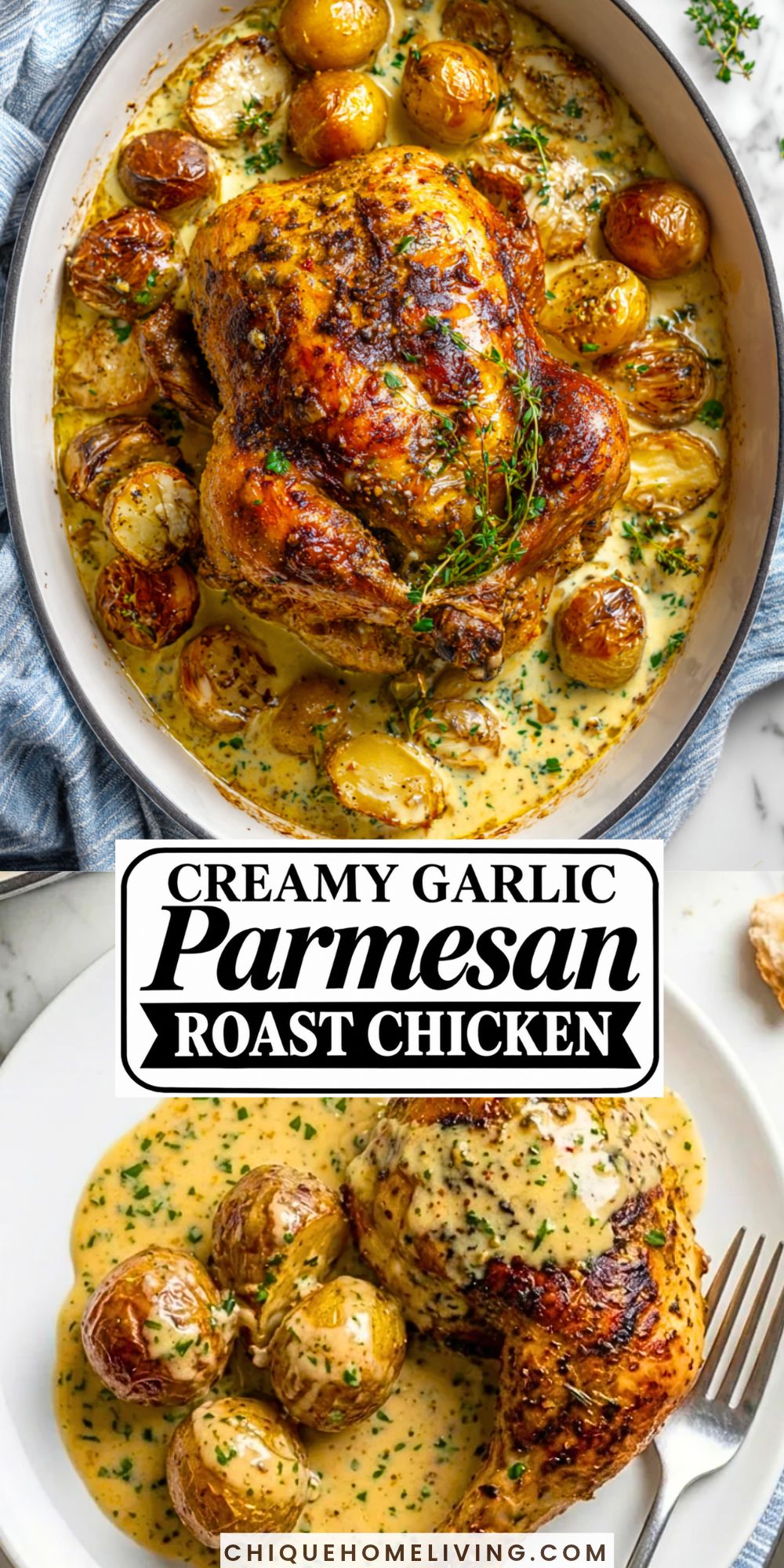
Creamy Garlic Parmesan Roast Chicken
Need an easy roast dinner for tonight that doesn’t take loads of effort?
This creamy garlic Parmesan chicken is cosy, filling and comes with golden baby potatoes already cooked right in the sauce.
This is the kind of dinner I’d make when I want roast chicken but don’t want a table full of separate dishes.
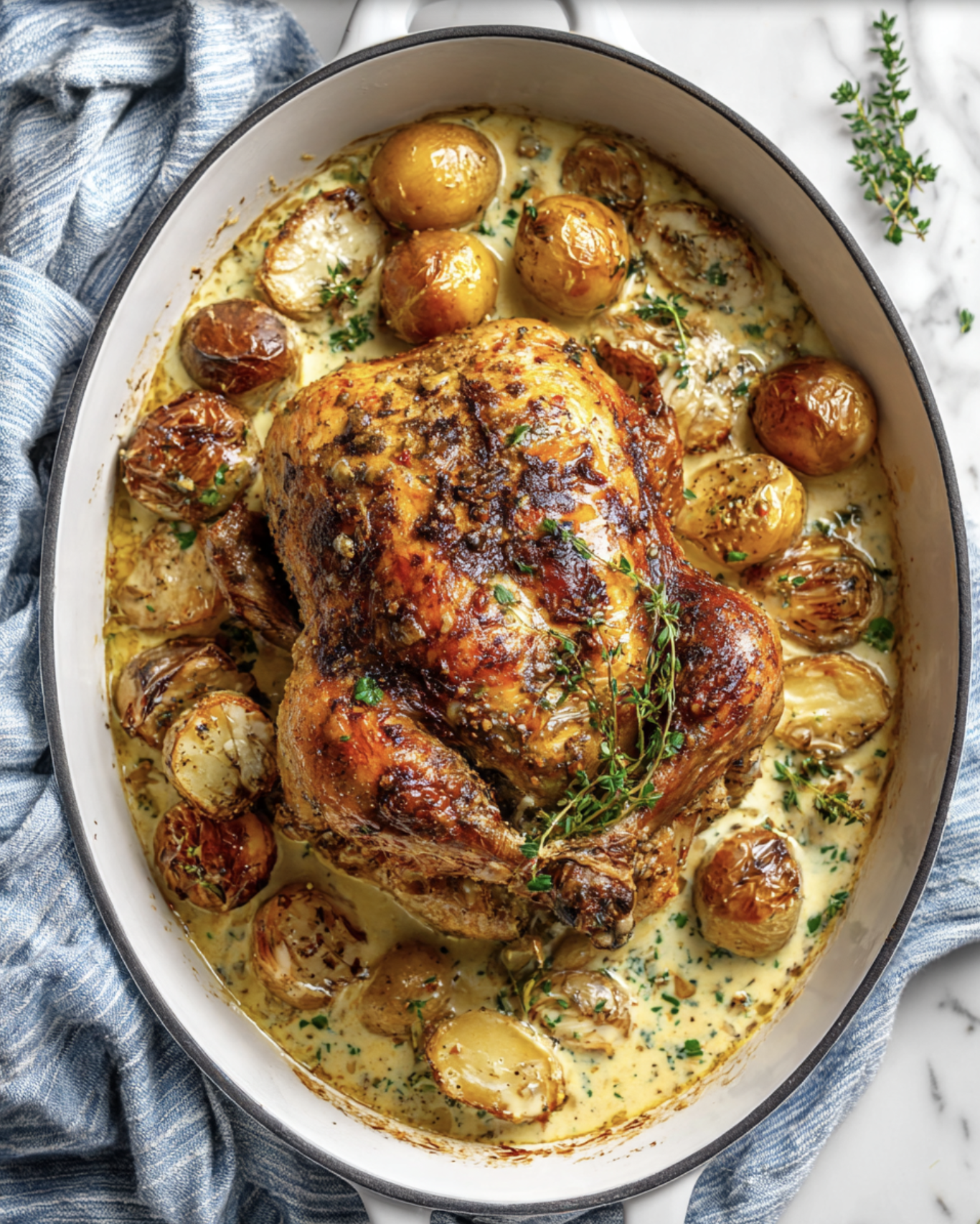
The chicken roasts until the skin is golden, and the baby potatoes cook around it in the creamy garlic Parmesan sauce.
By the time everything is ready, the potatoes are soft, the sauce is rich and garlicky, and there’s plenty to spoon over the chicken.
I like keeping the rest simple because there’s already a lot going on in the pan.
A few herbs over the top and maybe some green vegetables on the side are enough.
It’s warm, easy and filling, and most of the dinner is already sorted in one roasting dish.
What You’ll Need
For the chicken
- 1 whole chicken, about 1.8 to 2.2 kg
- 2 tablespoons olive oil
- 60 g softened butter
- 4 garlic cloves, finely minced
- 1 tablespoon fresh thyme leaves
- 1 teaspoon dried oregano
- 1 teaspoon garlic powder
- 1 teaspoon onion powder
- 1 1/2 teaspoons salt
- 1 teaspoon black pepper
For the baby potatoes
- 800 g baby potatoes
- 1 tablespoon olive oil
- Salt, to taste
- Black pepper, to taste
For the roasted garlic and herbs
- 2 whole garlic bulbs, separated into large cloves or halved
- 5 to 6 sprigs fresh thyme
- 250 ml chicken stock
For the parmesan cream sauce
- 250 ml double cream
- 80 g finely grated parmesan
- 1 teaspoon Dijon mustard
- 1 tablespoon chopped fresh parsley
- Black pepper, to taste
- Salt, only if needed
Start With a Properly Dry Chicken
This is not the exciting part, but it is one of the reasons the skin ends up looking so good.
Pat the chicken dry really thoroughly with kitchen paper.
Get around the legs, underneath the wings and over the breast.
Wet skin steams.
Dry skin browns.
It really is that simple.
Once the chicken is dry, the butter mixture has something to cling to as well, which means you get all that garlic, thyme and seasoning sitting right against the skin instead of sliding straight into the bottom of the roasting dish.
How to Make It
Prepare the chicken
- Heat the oven to 200°C / 180°C fan / 400°F.
- Pat the chicken completely dry.
- In a bowl, mix the softened butter with the minced garlic, thyme, oregano, garlic powder, onion powder, salt and black pepper.
- Rub the olive oil over the chicken.
- Spread the garlic herb butter generously over the skin.
- Rub a little underneath the breast skin too if you can do it without tearing it.
- Set the chicken breast-side up in a large roasting dish or Dutch oven.
Add the potatoes and garlic
- Toss the baby potatoes with olive oil, salt and black pepper.
- Arrange them around the chicken.
- Add the garlic cloves and fresh thyme sprigs around the potatoes.
- Pour the chicken stock into the bottom of the pan.
- Try not to pour it over the chicken because you want the butter mixture to stay on the skin.
Roast
- Roast the chicken uncovered for about 1 hour 15 minutes to 1 hour 35 minutes, depending on its size.
- After about 45 minutes, spoon some of the pan juices over the potatoes.
- Turn a few of the potatoes if they need more colour.
- If the chicken skin is getting too dark before the meat is cooked, cover the breast loosely with foil.
- Continue roasting until the chicken is cooked through and the potatoes are tender and golden.
- The thickest part of the thigh should reach 74°C / 165°F.
Rest the chicken
- Carefully transfer the chicken to a board or large plate.
- Let it rest for 15 to 20 minutes.
- Leave the potatoes, garlic and pan juices in the roasting dish.
Make the creamy parmesan sauce
- Place the roasting dish over low heat if it is hob-safe, or transfer the pan juices, potatoes and garlic to a large skillet.
- Pour in the double cream.
- Stir gently.
- Add the Dijon mustard.
- Let the sauce simmer gently for 2 to 3 minutes.
- Stir in the parmesan a little at a time.
- Keep the heat low so the cheese melts smoothly.
- Add the parsley and black pepper.
- Taste before adding salt because the parmesan and roasting juices already bring plenty.
Finish
- Return the rested chicken to the centre of the creamy potatoes.
- Spoon a little sauce around the chicken, leaving the crispy top exposed.
- Scatter over a little extra parsley or thyme.
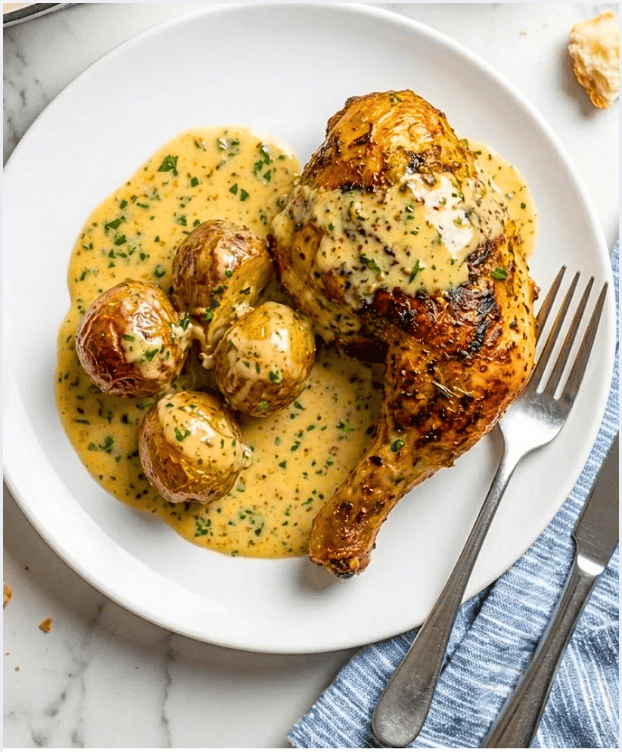
- Serve with plenty of the creamy garlic parmesan sauce spooned around each portion.
Keep the Chicken Skin Above the Sauce
This matters.
The sauce belongs around the chicken, not poured over every inch of it.
You have spent all that time getting the skin golden and crisp.
Do not immediately make it soggy.
Keep the breast and most of the legs above the creamy sauce.
Then when you carve the chicken, spoon the sauce over the meat itself.
That way you get crisp skin and creamy sauce in the same bite.
Far better arrangement.
Those Potatoes Should Actually Roast
The potatoes should have browned patches and wrinkled golden skins.
They are not supposed to look boiled.
Use baby potatoes that are fairly similar in size.
If some are much larger, halve them.
They need enough room around the chicken to actually catch heat.
If the pan is completely crammed, they will cook, but they will not develop nearly as much colour.
And once the cream sauce goes in, that roasted flavour is important.
The potatoes soften slightly in the sauce but still keep those browned edges.
That is exactly what you want.
Roasted Garlic Makes the Sauce Better
Raw garlic and roasted garlic give you very different flavours.
Raw garlic is sharp and punchy.
Roasted garlic becomes sweet, soft and mellow.
In this recipe, you get a little of both.
The minced garlic in the butter seasons the chicken.
The whole garlic roasting in the pan flavours the potatoes and eventually the cream sauce.
Some of the cloves may practically melt by the time the sauce is finished.
That is excellent news.
You can mash them lightly into the cream if you want an even stronger roasted garlic flavour.
Keep the Parmesan Sauce Silky
Once the parmesan goes in, lower heat is your friend.
Do not boil the sauce aggressively.
Parmesan melts much more smoothly over gentle heat.
Finely grated parmesan is best because it disappears into the cream quickly instead of forming little stubborn cheese clumps.
If the sauce becomes thicker than you want, add a splash of chicken stock.
You want it creamy and spoonable.
It should pool around the potatoes naturally rather than sitting there like cheese paste.
Why Dijon Works Here
You will not really taste mustard.
That is not the point.
A teaspoon of Dijon gives the creamy sauce a little sharpness that balances the butter, cream and parmesan.
Without something slightly acidic or sharp, creamy sauces can start tasting flat after a few bites.
The mustard quietly fixes that.
Lemon could do something similar, but Dijon fits better with the roasted garlic and thyme in this particular sauce.
Don’t Forget to Rest the Chicken
A whole chicken needs a few minutes before carving.
Fifteen to twenty minutes is plenty.
That gives the juices time to settle back into the meat.
It also gives you the perfect window to finish the sauce.
So instead of standing around impatiently staring at the chicken, you actually have something useful to do.
By the time the sauce is ready, the chicken is rested.
Everybody wins.
What to Serve With It
Honestly, you already have most of dinner in the pan.
Chicken.
Potatoes.
Sauce.
That is a strong start.
If you want something green alongside it, keep it simple.
Good options include:
- Roasted asparagus
- Tenderstem broccoli
- Green beans
- Peas
- A crisp green salad
- Roasted Brussels sprouts
I would choose something fresh or green rather than another creamy side.
The potatoes already have that department handled.
Can You Make It Ahead?
You can prepare the garlic herb butter a day ahead.
You can also season the chicken several hours before roasting and keep it uncovered in the fridge.
That actually helps dry the skin further.
The potatoes can be washed and prepared ahead too.
I would roast the whole dish fresh though.
The chicken skin and roasted potatoes are at their best straight from the oven.
The sauce comes together so quickly at the end that there really is no reason to make it separately in advance.
Storage
Store leftover chicken, potatoes and sauce in airtight containers in the fridge for up to 3 days.
If possible, keep the chicken separate from the sauce.
That helps preserve the skin a little better.
Reheat the chicken and potatoes in the oven.
Warm the sauce separately over low heat.
If it thickens in the fridge, loosen it with a splash of chicken stock or cream.
Q&A
Can I use chicken thighs instead of a whole chicken?
Yes.
Bone-in, skin-on thighs would work really well.
They will cook much faster, so start checking them after about 35 to 40 minutes.
Can I use boneless chicken?
Yes, but the finished dish will look and feel different.
Boneless thighs would be my first choice because they stay juicy.
Can I use larger potatoes?
Yes.
Cut them into smaller roast-size pieces so they cook at the same pace as the chicken.
Can I use single cream?
Yes.
The sauce will be lighter and a little thinner, but it will still work.
Can I leave out the parmesan?
You can, but then it becomes more of a garlic cream sauce.
The parmesan adds savoury depth and helps thicken it.
Why did my sauce split?
The heat was probably too high when the parmesan went in.
Keep the cream at a gentle simmer and add the cheese gradually.
Can I add mushrooms?
Yes.
Brown sliced mushrooms separately and stir them into the cream sauce before serving.
Can I add spinach?
Yes.
A handful of spinach stirred into the hot sauce at the end would work nicely.
How do I know the chicken is cooked?
The thickest part of the thigh should reach 74°C / 165°F, and the juices should run clear.
Can I make this without potatoes?
Yes.
Roast the chicken with the garlic and herbs, then make the cream sauce from the pan juices.
Serve it with mashed potatoes, rice or vegetables instead.