Saffron Pomegranate Rice
Ever put a bowl of rice on the table and had everyone ask about the rice before the main dish?
With its golden saffron grains, sweet pops of pomegranate, crisp fried onions, and pistachios, this one has serious main-character energy for a side dish.
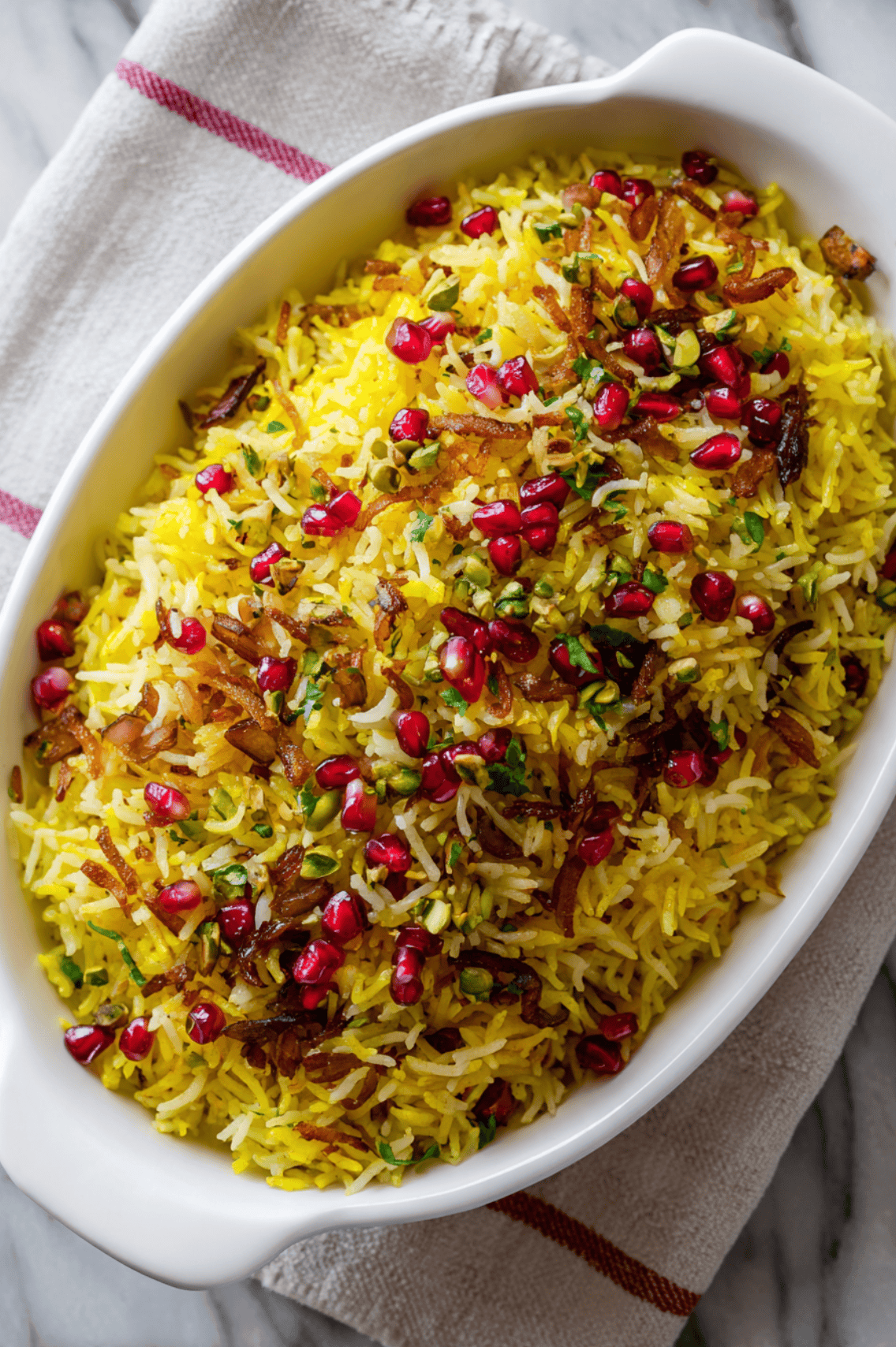
How pretty can a bowl of rice reasonably be?
Apparently, very.
The saffron turns the basmati that gorgeous golden yellow, but then you get these ruby-red pomegranate seeds scattered through it and suddenly plain rice feels very far away.
I especially like the fried onions here. They bring those dark, crisp little bits that make every few forkfuls slightly different, while the pistachios give you a proper crunch rather than just sitting on top for decoration.
Then you hit a pomegranate seed and get that fresh, tart sweetness against the warm rice.
It’s colourful enough for Christmas or a dinner party, but there’s nothing particularly complicated about making it.
Put the serving dish down as it is and let the colours do the showing off.
Why You’ll Want This on the Table ASAP
- The basmati stays fluffy with long, separate grains.
- Saffron gives the rice its warm golden colour and delicate floral flavour.
- Caramelised onions add a savoury sweetness that works beautifully with the pomegranate.
- Pistachios and toasted almonds bring crunch without making the rice heavy.
- Fresh pomegranate gives the whole dish a juicy, tart lift.
- It looks special enough for Christmas or entertaining without being difficult to make.
What You’ll Need
For the Saffron Rice
- 2 cups basmati rice
- 1/2 teaspoon saffron threads
- 3 tablespoons hot water
- 2 tablespoons unsalted butter
- 1 tablespoon olive oil
- 3 cups water or light chicken stock
- 1 teaspoon fine salt, plus more to taste
- 2 green cardamom pods, lightly crushed
- 1 small cinnamon stick
- 1 bay leaf
For the Caramelised Onions
- 2 medium onions, thinly sliced
- 1 tablespoon olive oil
- 1 tablespoon butter
- Small pinch of salt
For the Topping
- 1/2 cup fresh pomegranate seeds
- 1/3 cup shelled pistachios, roughly chopped
- 1/4 cup sliced or slivered almonds
- 2 tablespoons finely chopped fresh parsley
How to Make It
- Bloom the saffron.
Add the saffron threads to a small bowl and crush them very lightly between your fingers. Pour over the hot water and leave for 10 to 15 minutes, until the water turns a deep golden-orange colour. - Rinse the rice.
Place the basmati in a sieve and rinse thoroughly under cold running water until the water runs mostly clear. Leave it to drain while you prepare the onions. - Caramelise the onions.
Heat 1 tablespoon olive oil and 1 tablespoon butter in a frying pan over medium-low heat. Add the sliced onions and a small pinch of salt. - Cook the onions slowly.
Let them cook for around 20 to 25 minutes, stirring every few minutes, until deeply golden brown with some darker crisp edges. Transfer to a plate and set aside. - Toast the almonds.
Add the almonds to a dry frying pan over medium-low heat and toast for 2 to 3 minutes, shaking the pan often. Remove as soon as they smell nutty and take on a little colour. - Toast the pistachios briefly.
Add the pistachios to the same pan for about 1 minute. Keep them mostly green rather than browning them heavily. - Start the rice.
Melt 2 tablespoons butter with 1 tablespoon olive oil in a large saucepan over medium heat. - Warm the whole spices.
Add the cardamom pods, cinnamon stick and bay leaf. Cook for about 30 seconds, just until fragrant. - Add the rice.
Tip in the drained basmati and gently stir for about 1 minute so the grains are coated in the butter. - Add the liquid.
Pour in the water or stock, add the salt and stir in roughly three-quarters of the bloomed saffron water. - Cook gently.
Bring to a simmer, then immediately cover with a tight-fitting lid and reduce the heat to the lowest setting. - Steam the rice.
Cook for 12 minutes without lifting the lid. - Rest it.
Remove the pan from the heat and leave it covered for another 10 minutes. This finishes the rice gently and helps keep the grains separate. - Remove the spices.
Take out the cinnamon stick, bay leaf and cardamom pods. - Add the final saffron colour.
Drizzle the remaining saffron water over different parts of the rice rather than pouring it all into one spot. - Fluff carefully.
Use a fork to gently lift and separate the rice. Try not to stir aggressively or you will break the long basmati grains. - Add some of the onions.
Fold about half of the caramelised onions gently through the rice. - Transfer to a serving dish.
Spoon the rice into a wide serving bowl or shallow casserole dish. - Finish the top.
Scatter over the remaining caramelised onions, toasted almonds, chopped pistachios and fresh pomegranate seeds. - Add the final garnish.
Finish with chopped parsley and serve while the rice is still warm.
How to Keep the Rice Fluffy
A few small details make a huge difference here:
- Rinse the basmati properly before cooking.
- Drain it well before it goes into the pan.
- Use the measured amount of liquid rather than guessing.
- Keep the lid closed while the rice cooks.
- Let it rest after cooking before touching it.
- Fluff with a fork instead of stirring with a spoon.
- Add the pomegranate only at the end.
Getting That Golden Saffron Colour
The rice should not look completely uniform.
Some grains can be deeper yellow while others remain a little paler.
That variation is exactly what gives saffron rice its more natural appearance.
Adding most of the saffron water before cooking and the final little bit afterwards helps create that look.
What to Serve With It
This works particularly well alongside:
- Roast chicken
- Roast turkey
- Grilled chicken skewers
- Lamb chops
- Slow-roasted lamb
- Grilled salmon
- Spiced meatballs
- Roasted vegetables
- Cucumber yoghurt salad
It also makes a gorgeous Christmas side because the red pomegranate and green pistachios already bring plenty of colour to the table.
Make-Ahead Tips
- Caramelise the onions up to 1 day ahead and refrigerate them.
- Toast the nuts ahead and keep them in an airtight container once cool.
- Wash and dry the parsley in advance.
- Remove the pomegranate seeds ahead of time and refrigerate them.
- Cook the rice as close to serving time as possible for the best texture.
- If reheating, cover the rice and warm it gently with a tiny splash of water.
Q&A
Can I use turmeric instead of saffron?
You can use turmeric to make yellow rice, but the flavour will be completely different.
Turmeric is earthy and more assertive, while saffron is floral and delicate.
For this particular rice, saffron is worth using.
Can I use only pistachios?
Yes.
The almonds add another texture, but the recipe still works perfectly with pistachios alone.
Why did my rice turn sticky?
The most common reasons are:
- The rice was not rinsed enough.
- Too much liquid was added.
- The rice was stirred while cooking.
- It was cooked for too long.
- It was not allowed to rest before fluffing.
Should I soak the basmati?
You can soak it for around 20 minutes if you prefer especially long grains.
Drain it thoroughly before cooking and reduce the cooking time slightly if necessary.
For this recipe, a thorough rinse is enough.
Can I use stock?
Yes.
A light chicken or vegetable stock works well.
Avoid anything too strongly flavoured because the saffron should still be noticeable.
When should I add the pomegranate?
Right at the end.
Adding it after the rice has finished cooking keeps the seeds juicy, fresh and bright red.
Final Scoop
The combination is simple, but every part matters.
The rice needs to stay fluffy.
The onions need enough time to become properly caramelised.
The saffron should be fragrant rather than drowned out by other spices.
And the pomegranate, pistachios and almonds should be scattered over generously enough that you get a little of everything in each serving.
That is what gives you that beautiful platter of golden rice with dark caramelised onions, jewel-like pomegranate and plenty of green pistachio running through the top.