Korean Bulgogi Beef
The onions might be my favourite part of this, which says a lot considering there’s a whole plate of beef involved.
They go sweet and slightly charred in the pan, then get tangled up with thin slices of savoury bulgogi beef, spring onions, sesame seeds, and plenty of fluffy rice.
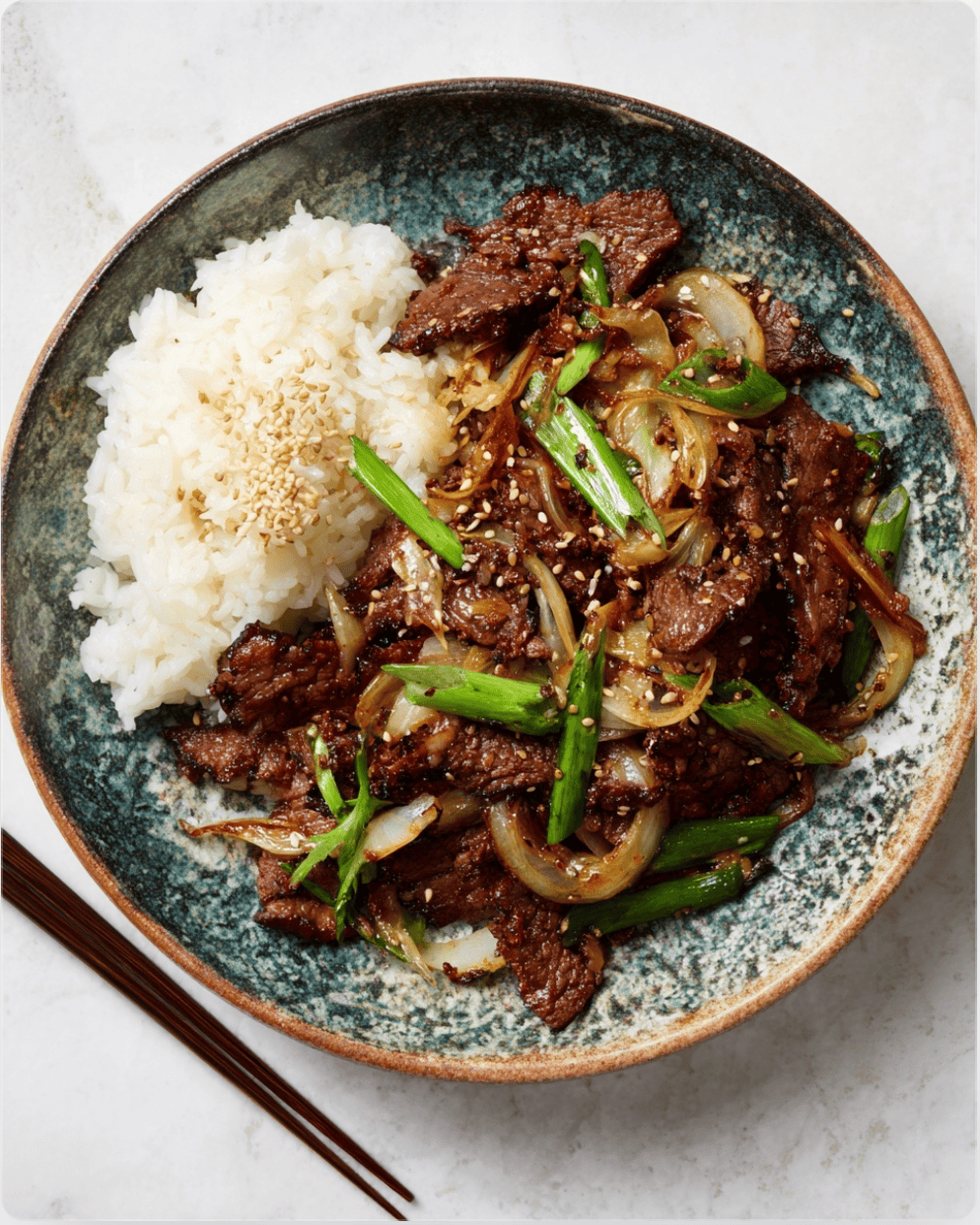
Bulgogi is one of those dinners where I start picking at the pan before I’ve even served it.
The beef cooks quickly, which is exactly what you want here, and the marinade turns glossy around the edges as it hits the heat.
Some pieces catch a little more than others, and those darker caramelised bits are absolutely the ones I’m going for first.
The onions soften right alongside the beef and soak up all that salty-sweet flavour, while the spring onions stay fresh enough to give everything a bit of bite.
I keep the rice plain because the beef really doesn’t need any competition.
A sprinkle of sesame seeds over the top, maybe a little extra spring onion, and that’s it.
Fast, deeply savoury, a little sticky, and very hard to stop eating.
Why You’ll Love This Recipe
- The beef cooks in minutes once it has finished marinating.
- Thin slices give you lots of caramelised edges without drying out the middle.
- Onion cooks right alongside the beef and soaks up the marinade.
- Spring onions add freshness and a little bite at the end.
- The marinade is sweet, salty, garlicky, and savoury without becoming syrupy.
- Plain white rice is all you really need beside it.
- It reheats surprisingly well, so any leftovers are very useful the next day.
Ingredients
This recipe serves about 4 people.
For the bulgogi beef
- 600g ribeye, sirloin, or another tender beef steak
- 1 medium onion, sliced into thin wedges
- 4 spring onions, cut into chunky diagonal pieces
- 1 tablespoon neutral cooking oil
- 1 tablespoon sesame seeds
For the bulgogi marinade
- 1/4 cup soy sauce
- 2 tablespoons brown sugar
- 1 tablespoon honey
- 1 tablespoon sesame oil
- 4 garlic cloves, finely grated or minced
- 1 teaspoon finely grated fresh ginger
- 1 tablespoon rice vinegar
- 1/2 teaspoon freshly ground black pepper
- 2 tablespoons grated Asian pear or grated apple
For serving
- Cooked fluffy white rice
- Extra sesame seeds, if you like
A Few Ingredient Notes
Ribeye is especially good for bulgogi because the little streaks of fat keep the thin beef tender while it cooks.
Sirloin is a perfectly good option too.
Whichever cut you use, slicing it thinly matters much more than buying the most expensive steak in the shop.
The pear or apple in the marinade is worth adding.
It gives the beef a little sweetness, but more importantly, it helps tenderise it.
You do not taste a strong fruity flavour once everything is cooked.
The spring onions are best left fairly chunky.
Tiny little slices would disappear into the beef, and I like getting those proper green pieces throughout the finished dish.
How to Slice the Beef Thinly
Trying to cut soft room-temperature steak into paper-thin pieces is irritating.
There is an easier way.
Put the beef in the freezer for around 25 to 35 minutes before slicing.
You do not want it frozen solid.
You just want it firm enough that your knife can make thin, clean slices.
Then slice against the grain.
Aim for pieces around 2 to 3mm thick if you can.
Do not worry if every slice is not identical.
Mine never are.
How to Make Korean Bulgogi Beef
1. Make the marinade
Add the soy sauce, brown sugar, honey, sesame oil, garlic, ginger, rice vinegar, black pepper, and grated pear or apple to a large bowl.
Stir until the sugar has mostly dissolved.
Taste a tiny bit.
It should be salty and savoury first, with enough sweetness to balance the soy sauce.
Remember that it will become more concentrated once it hits the hot pan.
2. Marinate the beef
Add the thinly sliced beef to the bowl.
Use your hands or tongs to gently separate the slices so the marinade can get between them.
Add about half of the sliced onion.
Toss everything thoroughly.
Cover and refrigerate for at least 30 minutes.
If I have time, I usually leave it for 2 to 4 hours.
You can marinate it overnight, but with very thin beef I do not find it necessary.
3. Get the pan properly hot
Use a large heavy frying pan, cast-iron skillet, or wok.
Set it over high heat and let it get hot before adding the oil.
You want to hear a strong sizzle when the beef goes in.
If the pan is lukewarm, all that marinade starts releasing water and the meat boils instead of caramelising.
That is not what we are after.
4. Cook the beef in batches
Lift some of the beef from the marinade, allowing the excess liquid to drip off.
Add it to the hot pan in a single layer.
Cook for around 1 to 2 minutes without constantly moving it.
Let the bottom get dark and caramelised.
Flip or toss the beef and cook for another minute.
Remove it to a plate and repeat with the remaining beef.
Do not pile everything into the pan at once.
Bulgogi cooks ridiculously quickly, so doing two or three batches really does not add much time.
And the difference in browning is worth it.
5. Cook the onions
Once the beef is finished, add the remaining onion to the same pan.
There should already be plenty of flavour sitting on the bottom.
Cook for about 2 to 3 minutes, tossing often.
The onions should soften and pick up some colour around the edges without turning completely limp.
If the pan gets dry, add the tiniest splash of oil.
6. Bring everything back together
Return all of the beef to the pan.
Add the chunky spring onions.
Pour in 1 or 2 tablespoons of the marinade if the pan needs a little moisture.
Toss over high heat for another minute or two.
The sauce should reduce quickly and cling to the beef.
You want glossy meat with caramelised patches rather than a bowl full of thin sauce.
Once the spring onions have softened slightly but are still bright green, take the pan off the heat.
7. Finish with sesame seeds
Scatter sesame seeds over the hot beef.
Give everything one final toss.
Taste a piece before adding anything else.
Soy sauce varies quite a bit in saltiness, so I rarely add extra salt until this point.
Usually, it does not need any.
How to Serve Bulgogi Beef
Spoon fluffy white rice onto one side of each bowl.
Pile the bulgogi next to it rather than burying the rice underneath.
Add plenty of the caramelised onion and spring onion from the pan.
Finish with another light scattering of sesame seeds.
I like the rice mostly plain.
The beef already has enough going on, and the soft rice is exactly what I want against those salty, caramelised edges.
Once a little of the bulgogi sauce starts soaking into the rice, even better.
Getting Those Dark Caramelised Edges
Heat and space are the two big things here.
The pan needs to be hot.
And the beef needs enough room around it.
If you add too much at once, moisture collects in the pan faster than it can evaporate.
The beef goes grey, the onions stew, and you lose all those lovely browned bits.
Another thing I do is avoid pouring the entire bowl of marinade into the skillet.
The beef carries enough marinade with it.
You can always add a spoonful later.
It is much harder to caramelise meat once it is swimming.
Don’t Overcook the Beef
Thin beef barely needs any time.
Once both sides have browned, it is usually ready.
Leaving it over the heat for another five minutes will not make it taste more cooked.
It will just make it chewy.
That is why I prep the onions and spring onions before I start cooking.
Once the pan gets going, everything moves quickly.
What to Serve With Bulgogi
White rice is enough for me most nights.
If you want a few extras, bulgogi also works well with:
- Kimchi
- Cucumber salad
- Steamed broccoli
- Stir-fried greens
- Lettuce leaves for wrapping
- Pickled vegetables
- Fried egg
You could also turn it into a rice bowl with cucumber, shredded carrot, and kimchi.
But I genuinely like the simpler plate.
Beef and rice leaves nowhere for the bulgogi to hide.
Storage and Reheating
Store leftover cooked bulgogi in an airtight container in the fridge for up to 3 days.
Keep the rice separately if possible.
To reheat the beef, add it to a hot frying pan with a teaspoon of water.
Toss just until heated through.
Do not leave it cooking for ages because the thin beef will toughen.
You can microwave it too.
I just prefer the frying pan because it gives some of those caramelised edges a second chance.
Q&A
What cut of beef is best for bulgogi?
Ribeye is my favourite because it stays beautifully tender.
Sirloin, rump, or another tender steak can also work.
The most important thing is slicing it very thinly against the grain.
Do I need an Asian pear?
No.
A regular pear or sweet apple works perfectly well.
You only need a small amount.
Can I marinate the beef overnight?
Yes.
Cover it well and refrigerate overnight.
If your beef is sliced extremely thinly, a few hours is already plenty.
Can I make bulgogi without sesame oil?
You can, although sesame oil gives it a very recognisable nutty flavour.
If you have it, I would use it.
Why did my beef turn watery?
The pan was probably overcrowded or not hot enough.
Cook in smaller batches and let the skillet heat properly between them.
Can I use ground beef?
You can make a bulgogi-style ground beef dish using the same flavours, but it will not have the same texture as traditional thinly sliced bulgogi.
Is bulgogi spicy?
Not usually.
This version is savoury and slightly sweet rather than hot.
If you want heat, serve it with kimchi or add a little gochugaru.
Final Thoughts
Bulgogi is one of those meals where I nearly always underestimate how much rice I am going to eat.
The beef is tender, the edges are dark and caramelised, and the onions end up sweet and savoury from cooking in all that marinade.
Then the spring onions come through with a fresher bite, and the sesame seeds add just enough nuttiness at the end.
It is not complicated food.
Most of the work happens before the pan even gets hot.
But once you get a forkful with beef, onion, a little spring onion, and warm rice together, it tastes like far more effort went into dinner than actually did.
That is a very good deal as far as I am concerned.