
Parmesan Crusted Salmon & Mash
Looking for something easy and comforting for dinner tonight?
This Parmesan crusted salmon with creamy mash is simple to make, full of flavour and perfect when you want a proper dinner without too much work.
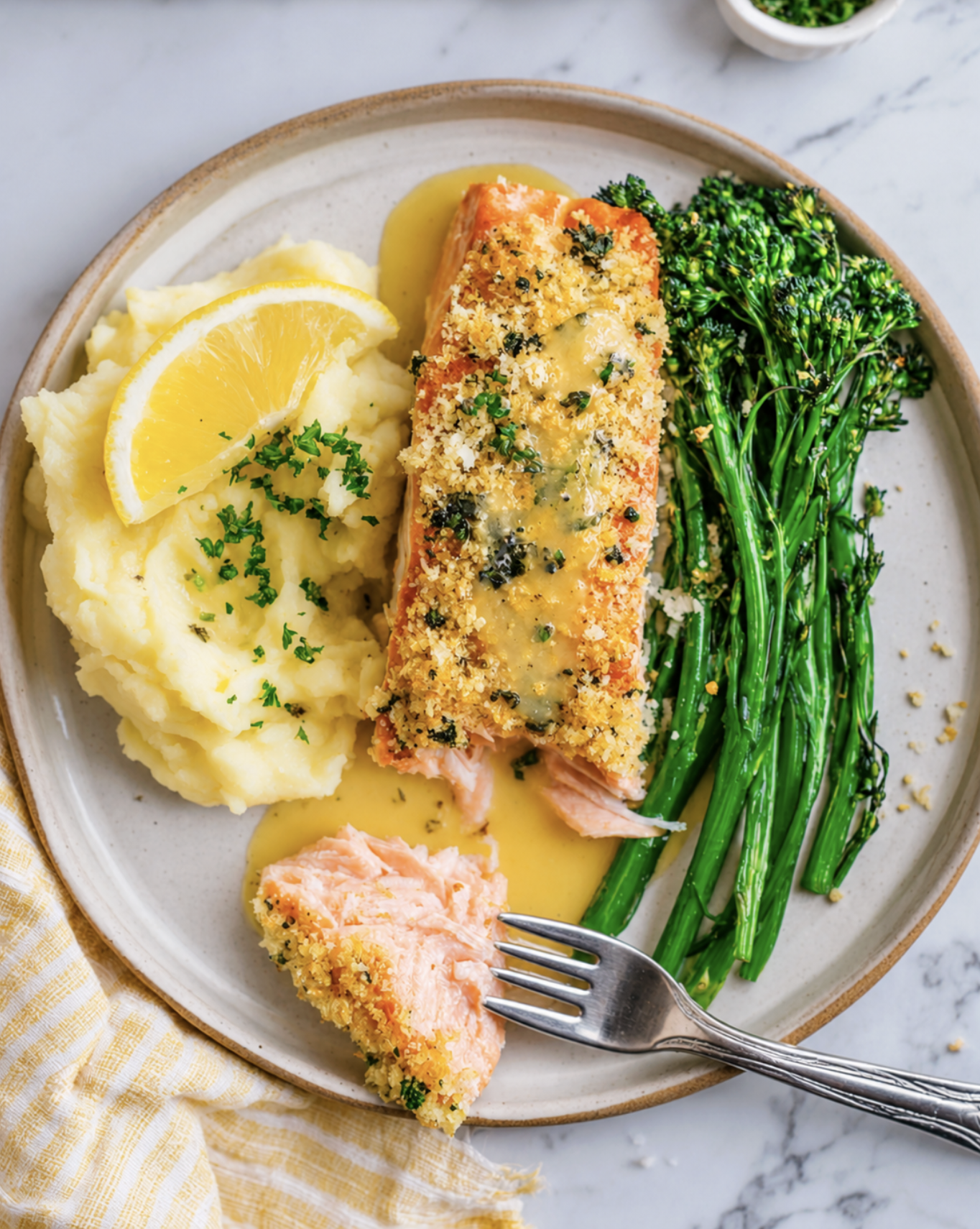
I would happily order this in a restaurant, which is funny because there is nothing particularly complicated happening here.
The salmon gets a simple parmesan crumb pressed over the top, then bakes until the crust turns golden while the centre stays moist.
The mashed potatoes are buttery with just enough lemon to make them taste fresh rather than heavy.
The broccolini gets roasted until the stalks are tender and the tips catch a little colour.
Then comes the garlic butter.
That sauce is not thick, creamy, or fussy.
It is just golden melted butter with garlic, lemon, and parsley, spooned over the salmon while everything is hot.
And yes, some of it absolutely should land in the mashed potatoes.
What You’ll Need
For the parmesan crusted salmon
- 4 thick salmon fillets
- 1 tablespoon olive oil
- 50 g finely grated parmesan
- 45 g panko breadcrumbs
- 2 tablespoons melted butter
- 2 tablespoons finely chopped parsley
- 1 teaspoon garlic powder
- 1/2 teaspoon dried oregano
- 1/2 teaspoon black pepper
- 1/2 teaspoon salt
- 1 teaspoon Dijon mustard
For the lemon butter mashed potatoes
- 900 g floury potatoes, peeled and chopped
- 60 g butter
- 80 to 120 ml warm milk
- 1 teaspoon finely grated lemon zest
- 1 tablespoon fresh lemon juice
- Salt, to taste
- Black pepper, to taste
- 1 tablespoon chopped parsley
For the roasted tenderstem broccolini
- 300 g tenderstem broccolini
- 1 tablespoon olive oil
- Salt, to taste
- Black pepper, to taste
For the golden garlic butter sauce
- 60 g butter
- 3 garlic cloves, finely chopped
- 1 tablespoon fresh lemon juice
- 1 tablespoon chopped parsley
- Pinch of black pepper
The Crust Should Be Golden, Not Thick
There is parmesan-crusted salmon, and then there is salmon wearing what looks like an entire loaf of bread.
I prefer the first.
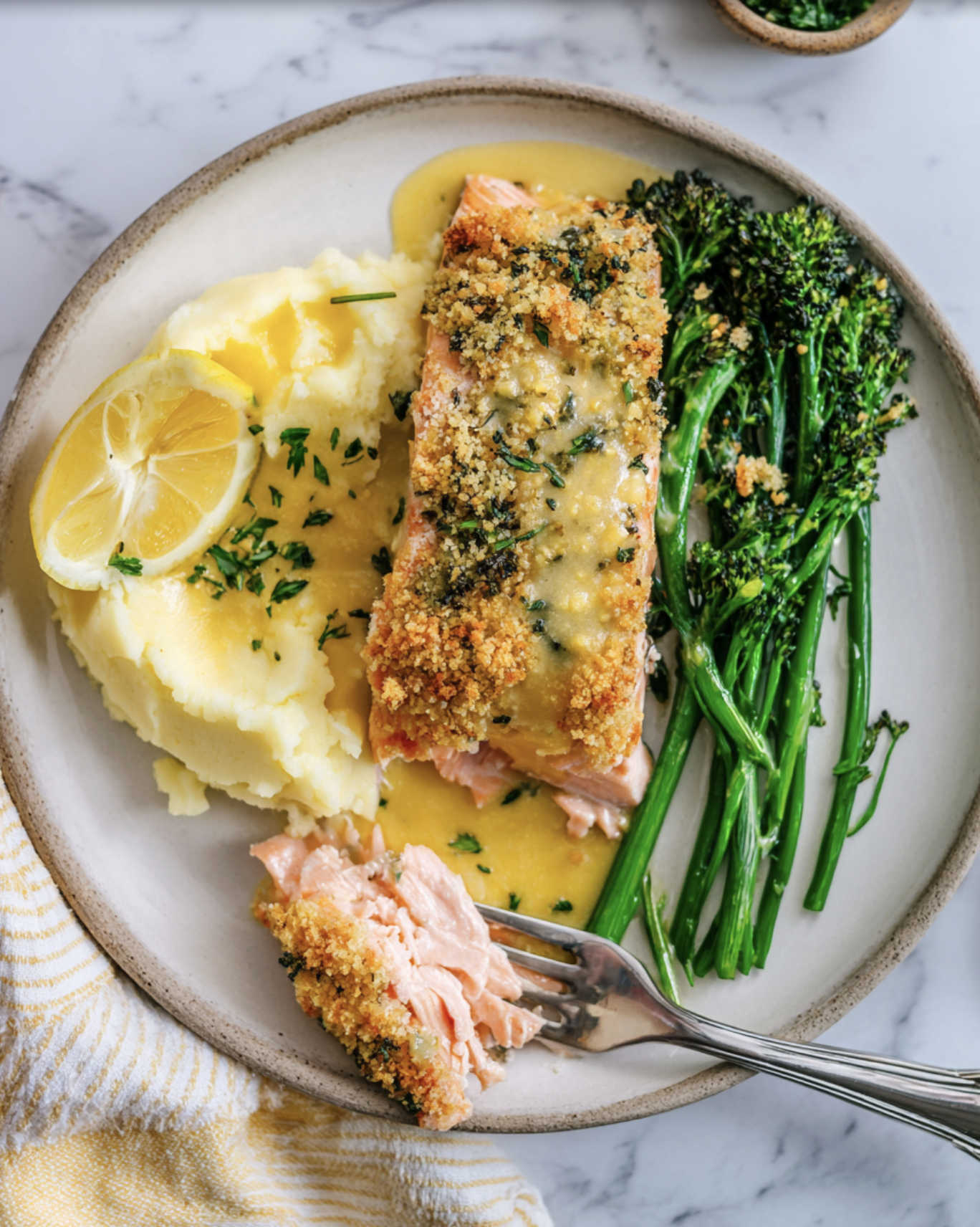
The crumb should be thick enough to give you a crisp, savoury top but not so heavy that the salmon disappears underneath it.
Panko breadcrumbs are particularly good here because they stay light and crisp.
Mixing them with parmesan and melted butter helps the topping brown evenly without needing a huge amount of oil.
The Dijon goes directly onto the salmon in a thin layer.
You will not get a strongly mustardy flavour.
It mostly gives the crumb something to hold onto and adds a little sharpness underneath all that parmesan.
How to Make It
Start the mashed potatoes
- Put the chopped potatoes into a large saucepan.
- Cover with cold salted water.
- Bring to the boil, then cook for about 15 to 18 minutes until completely tender.
- Drain thoroughly.
- Leave the potatoes in the colander for a minute or two so excess steam can escape.
- Return them to the pan.
Prepare the parmesan topping
- Add the parmesan, panko breadcrumbs, parsley, garlic powder, oregano, black pepper, and salt to a bowl.
- Pour in the melted butter.
- Stir until the crumbs are lightly coated.
- The mixture should feel loose and crumbly rather than wet.
Prepare the salmon
- Heat the oven to 200°C / 180°C fan / 400°F.
- Pat the salmon fillets dry with kitchen paper.
- Arrange them on a lined baking tray or in a lightly greased baking dish.
- Rub the salmon lightly with olive oil.
- Spread a thin layer of Dijon mustard over the top of each fillet.
- Press the parmesan crumb mixture firmly over the salmon.
- Do not coat the sides.
- Keep the topping mostly on the top surface so the pink salmon stays visible around the edges.
Roast the broccolini
- Place the tenderstem broccolini on a separate baking tray.
- Drizzle with olive oil.
- Season with salt and black pepper.
- Toss lightly.
- Roast for around 12 to 15 minutes until the stalks are tender and the florets have some darker roasted edges.
Bake the salmon
- Bake the salmon for around 12 to 15 minutes, depending on the thickness of your fillets.
- If the salmon is particularly thick, it may need another couple of minutes.
- The parmesan crust should be golden and crisp.
- The centre of the salmon should remain moist and flake into large pink pieces when gently pressed with a fork.
- If the crust needs more colour, place the salmon under the grill for 1 to 2 minutes at the end.
- Watch it closely because parmesan can go from golden to far too enthusiastic very quickly.
Finish the lemon butter mash
- Add the butter to the drained potatoes.
- Mash until smooth.
- Pour in the warm milk gradually until the potatoes are soft and silky.
- Stir in the lemon zest, lemon juice, parsley, salt, and black pepper.
- Taste before adding more lemon.
- The mash should taste buttery first, with a gentle fresh lemon flavour underneath.
Make the garlic butter sauce
- Melt the butter in a small pan over low heat.
- Add the chopped garlic.
- Cook gently for about 30 seconds.
- Do not let the garlic brown.
- Stir in the lemon juice, parsley, and black pepper.
- Remove from the heat.
Serve
- Spoon the lemon butter mashed potatoes onto each plate.
- Add the roasted tenderstem broccolini.
- Place the parmesan crusted salmon alongside.
- Spoon the warm golden garlic butter over the salmon.
- Let some of the sauce run naturally onto the mash.
- Serve immediately.
Keep the Salmon Moist in the Middle
This is the bit that matters most.
A gorgeous parmesan crust cannot rescue dry salmon.
Thick fillets work best because they give the topping enough time to become golden before the centre overcooks.
When you pull the salmon apart, the inside should separate into large, juicy flakes.
It should not crumble into tiny dry bits.
If your salmon fillets are thin, check them earlier.
Ten minutes may be enough.
Salmon has very little patience for people who decide to “give it another five minutes just in case.”
Check it.
If it flakes and still looks juicy, take it out.
Why Lemon Works in the Mash
I would not turn the mashed potatoes into lemon potatoes.
That would be too much.
The lemon is there quietly.
A little zest and a spoonful of juice are enough to cut through the butter and make the potatoes work better with the fish.
Add the milk gradually too.
Potatoes differ, and some need considerably less liquid than others.
You want mash that holds a soft mound on the plate while still being creamy.
Not stiff.
Not pourable.
Somewhere comfortably in the middle.
The Broccolini Needs Those Dark Edges
Roasting tenderstem broccolini is much more interesting than boiling it until it looks tired.
The stalks stay juicy, and the little florets catch heat quickly and become slightly crisp.
Those darker tips are good.
They bring a little bitterness that cuts through the butter, parmesan, and potatoes.
If your broccolini has especially thick stalks, split them lengthways.
That way the stalks will be tender by the time the tops are roasted.
Do Not Fry the Garlic Until Brown
The garlic butter is meant to taste soft and buttery.
Brown garlic changes the flavour completely.
Once the butter melts, add the garlic and keep the heat low.
Thirty seconds is usually plenty.
As soon as you can smell it, add the lemon and parsley and remove the pan from the heat.
The residual warmth keeps cooking the garlic anyway.
I have learned the hard way that “just another minute” and garlic are not close friends.
What Kind of Parmesan Works Best?
Freshly grated parmesan is worth using here.
It melts into the breadcrumb topping and develops those salty golden patches that make the crust so good.
Very coarse parmesan does not stick as evenly.
Pre-grated parmesan will technically work, but it can be drier and less flavourful.
A fine grater gives you the best texture.
And please do not bury the salmon under an inch of cheese.
Parmesan is quite salty and strong.
A sensible amount is much nicer.
Make the Plate Feel Balanced
There is quite a lot of richness happening between salmon, parmesan, butter, and mash.
The broccolini and lemon stop it from becoming overwhelming.
That is also why I would not add a thick cream sauce here.
The golden garlic butter is enough.
It gives moisture and flavour but still lets the crisp parmesan crust stay crisp.
A heavy sauce would soften the topping almost immediately.
Which would feel like doing all that breadcrumb work and then personally sabotaging it.
What Else Can You Serve With It?
This plate is already a complete meal, but you can swap the sides depending on what you have.
Good alternatives include:
- Green beans
- Asparagus
- Roasted broccoli
- Peas
- Crushed baby potatoes
- Saffron rice
- A simple green salad
If I were changing only one thing, I would swap the mash for roasted baby potatoes.
Everything else can stay exactly where it is.
Leftovers
Store leftover salmon in an airtight container in the fridge for up to 2 days.
Keep the mashed potatoes and broccolini in separate containers if possible.
The crust will soften slightly in the fridge.
That is unavoidable.
Reheat the salmon in the oven at a moderate temperature rather than microwaving it aggressively.
The microwave is very good at turning leftover salmon into something you could potentially use as a doorstop.
Warm the mash separately with a splash of milk and a little butter.
The broccolini only needs a short reheating.
Q&A
Can I use skin-on salmon?
Yes.
Place it skin-side down and add the parmesan crust to the top.
The skin also helps protect the bottom of the salmon during baking.
Can I use regular breadcrumbs?
Yes.
Panko gives a lighter, crunchier topping, but ordinary breadcrumbs still work.
Can I air fry the salmon?
Yes.
Cook it at around 190°C / 375°F for approximately 8 to 12 minutes depending on thickness.
Check it early so the parmesan does not burn.
Can I prepare the crust ahead?
Yes.
Mix the parmesan breadcrumb topping earlier in the day and refrigerate it until needed.
Can I leave out the Dijon mustard?
Yes.
A thin layer of mayonnaise can help the crumbs stick instead, or simply brush the salmon with a little olive oil.
Why did my parmesan topping fall off?
The salmon may have been too wet.
Pat the surface dry before adding the Dijon and press the crumb topping down gently.
Can I make the mash without milk?
Yes.
Use a little more butter plus some warm cream, stock, or even reserved potato cooking water.
What if my garlic butter separates?
That is completely fine.
It is melted butter, not an emulsified cream sauce.
Give it a quick stir before spooning it over the salmon.
Can I use frozen salmon?
Yes.
Thaw it completely in the fridge first and pat it very dry before adding the crust.
How do I know when the salmon is ready?
Gently press the thickest section with a fork.
The flesh should separate easily into moist flakes while still looking juicy in the centre.


