
Chinese Salt and Pepper Eggplant
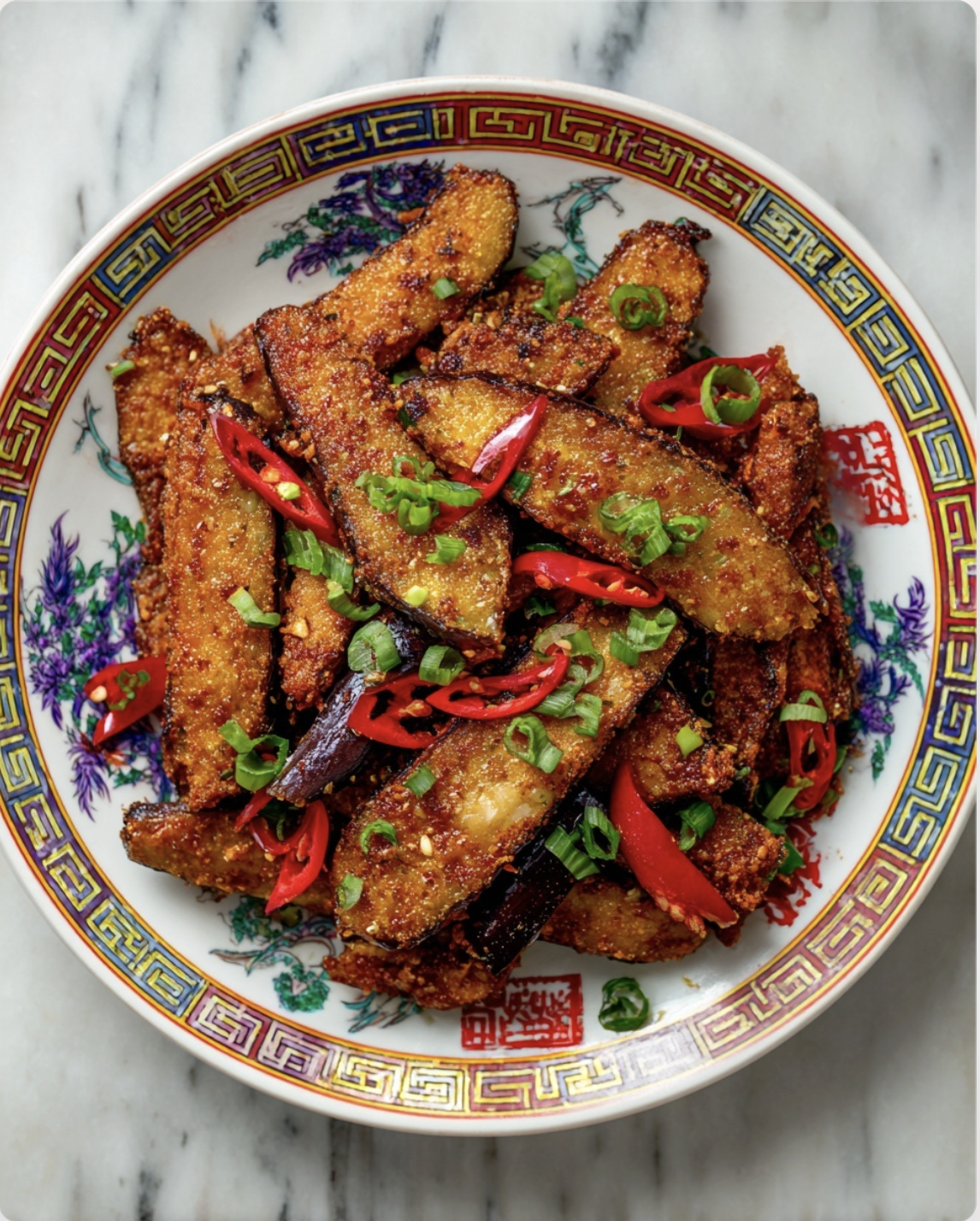
This salt and pepper eggplant is crispy on the outside, soft in the middle, and wildly easy to keep eating straight from the plate.
The eggplant strips are coated in cornstarch, pan fried until golden, then finished with red chilies and spring onion, with a simple dipping sauce on the side.
I love a recipe that manages to feel a little dramatic without actually being difficult.
This is one of those.
Eggplant has a way of going from slightly ignored vegetable to absolute main character once it’s crisped up properly.
The outside gets lightly craggy and golden, the inside turns silky, and the whole thing soaks up just enough seasoning to make every bite interesting.
This version keeps things simple and lets the texture do a lot of the work.
It’s salty, a little peppery, gently spicy from the fresh red chilies, and exactly the sort of dish that disappears faster than expected.
If you’ve ever had a plate of salt and pepper aubergine at a Chinese restaurant and immediately wished you’d ordered two, this is for you.
Why You’ll Love This Recipe
The best thing about this dish is the contrast.
You get that crisp coating outside, then soft, almost creamy eggplant in the centre.
It also looks like you did something impressive, even though the ingredient list is quite short.
Pan frying keeps it more manageable at home than deep frying.
And the dipping sauce gives you that extra punch of salty, tangy flavour without making the eggplant soggy.
It works as a starter, side dish, or a very convincing excuse to hover by the stove eating pieces as they finish cooking.
Ingredients
This serves 4 as a starter or side.
For the eggplant
- 2 medium eggplants
- 1 teaspoon fine sea salt
- 120g cornstarch
- 1 teaspoon white pepper
- ½ teaspoon ground black pepper
- ½ teaspoon fine sea salt
- ¼ teaspoon five spice powder, optional
- 4 to 5 tablespoons neutral oil, for pan frying
To finish
- 2 red chilies, thinly sliced
- 3 spring onions, thinly sliced
- ½ teaspoon flaky sea salt, or to taste
- ¼ teaspoon white pepper, or to taste
For the dipping sauce
- 2 tablespoons light soy sauce
- 1 tablespoon black vinegar or rice vinegar
- 1 teaspoon sesame oil
- 1 teaspoon sugar
- 1 tablespoon water
- ½ teaspoon finely grated ginger, optional
A Quick Note on Eggplant
You can make this with regular globe eggplants or long Asian eggplants.
Regular eggplants are easier to find, so that’s what I usually use.
Cut them into thick strips rather than tiny batons.
You want pieces that hold their shape in the pan and still give you that soft centre once cooked.
If you cut them too thin, they can go from crisp to floppy quite quickly.
That is not the vibe we’re aiming for.
Make the Dipping Sauce First
This only takes a minute, and it’s nice to have it ready before you start frying.
The sauce should be light and punchy.
It’s there to dip, not to drown the eggplant.
- In a small bowl, combine the soy sauce, vinegar, sesame oil, sugar and water.
- Add the grated ginger if using.
- Stir until the sugar dissolves.
- Set aside while you make the eggplant.
Taste it and adjust if needed.
If you like it sharper, add a tiny splash more vinegar.
If you want it slightly sweeter, add a pinch more sugar.
Prep the Eggplant Properly
Eggplant can hold quite a bit of moisture, so I like to salt it briefly first.
This helps it season all the way through and gives the texture a better start.
- Cut the eggplants into thick strips, around finger length.
- Place them in a colander or on a tray.
- Sprinkle with 1 teaspoon fine sea salt.
- Leave them for 20 minutes.
You’ll notice some moisture collecting on the surface.
That’s exactly what you want.
- Pat the eggplant dry thoroughly with kitchen paper or a clean tea towel.
Do not skip drying them well.
If the surface is still wet, the cornstarch coating turns patchy and clumpy.
Mix the Coating
The coating is simple, but it matters.
Cornstarch gives the eggplant that light crisp shell without feeling heavy.
- In a wide bowl, mix together the cornstarch, white pepper, black pepper, salt and five spice if using.
- Toss the dried eggplant strips through the cornstarch mixture.
- Turn them well so every piece is evenly coated.
- Shake off any obvious excess.
You want a proper coating, but not thick dusty clumps.
A light, even layer is what gives the best texture.
Pan Fry Until Crispy
This is the bit where it all starts looking very promising.
Use a large frying pan so the eggplant has space.
If the pieces are piled on top of each other, they steam instead of fry.
- Heat 2 to 3 tablespoons of neutral oil in a large frying pan over medium-high heat.
- Add the coated eggplant in a single layer.
- Fry for 3 to 4 minutes on the first side.
- Turn the pieces and fry for another 3 to 4 minutes.
- Add a little more oil if the pan looks dry.
- Continue turning until the eggplant is golden brown and crisp on most sides.
Work in batches if needed.
It’s much better to take your time than crowd the pan and end up with pale, limp eggplant.
Transfer the cooked pieces to a plate lined with kitchen paper while you finish the rest.
Finish with Chilies and Spring Onion
Once all the eggplant is crisp, give the pan a quick wipe if it’s full of loose burnt starch bits.
Then do the final quick toss.
- Add a tiny splash of oil to the pan if needed.
- Add the sliced red chilies and cook for about 20 to 30 seconds.
- Add most of the spring onion.
- Return the eggplant to the pan.
- Sprinkle over the flaky sea salt and white pepper.
- Toss everything together for about 30 seconds.
That’s it.
You’re not trying to cook it for ages at this stage.
You just want the chili and spring onion warmed through and the seasoning evenly distributed.
Scatter the remaining spring onion over the top before serving.
How to Serve It
This is best served immediately while the coating is still crisp.
Pile the eggplant into a bowl or onto a plate.
Scatter over a few extra slices of red chili if you like.
Serve the dipping sauce on the side.
It’s excellent as part of a bigger dinner with rice, noodles or other small dishes.
It also makes a very good snack plate if that happens to be the sort of evening you’re having.
No judgement from me.
Tips for the Best Salt and Pepper Eggplant
Dry the eggplant well after salting.
That’s what helps the cornstarch cling evenly.
Use enough oil.
You are pan frying, not dry-toasting.
The coating needs proper contact with hot oil to crisp up.
Do not overcrowd the pan.
This is the main thing that separates crispy eggplant from disappointing eggplant.
Season at the end too.
The final sprinkle of salt and white pepper brings the whole thing together.
Serve it quickly.
Crispy eggplant waits for nobody.
It’s still good later, but it’s at its absolute best fresh from the pan.
Q&A
Do I have to salt the eggplant first?
Not strictly.
You can skip it if you’re short on time.
I still recommend it because it improves the texture and helps remove some excess moisture.
Can I make this less spicy?
Yes.
Use fewer red chilies, or leave them out completely.
You’ll still get plenty of flavour from the salt, pepper and spring onion.
What does white pepper do here?
White pepper gives that classic salt and pepper flavour you often get in Chinese restaurant dishes.
It has a slightly different warmth from black pepper.
If you only have black pepper, the dish will still work, but white pepper really gives it the right feel.
Can I air fry it instead?
You can.
The texture will be a little different, but still good.
Lightly oil the coated eggplant and air fry at 200°C for about 12 to 15 minutes, turning halfway through.
Can I make it gluten-free?
Yes.
Use a gluten-free soy sauce or tamari in the dipping sauce.
Everything else is naturally easy to adapt.
Why is my eggplant soggy?
Usually one of three things happened.
The pan was crowded.
The oil was not hot enough.
Or the eggplant sat too long before serving.
Can I use another vegetable?
Yes.
Courgette and tofu can work with a similar salt and pepper treatment.
Still, eggplant is especially good here because that soft centre against the crisp coating is half the appeal.
Storage and Reheating
This dish is best eaten straight away.
That said, leftovers can be kept in an airtight container in the fridge for up to 2 days.
To reheat, spread the eggplant out on a tray and warm it in a hot oven or air fryer until heated through.
That helps bring back some of the crispness.
The microwave will heat it, but it won’t do the texture any favours.
Store the dipping sauce separately if possible.
Final Thoughts
This is the sort of recipe I make when I want something snacky, savoury and just a little bit addictive.
It’s crisp, salty, peppery and has enough chili heat to keep things interesting without setting your mouth on fire.
The dipping sauce gives it that extra little lift, but the eggplant is strong enough to stand on its own too.
Honestly, that may be the biggest compliment I can give eggplant.
Serve it hot, pass the sauce around, and do not expect leftovers.