Vegan Peperonata with Mixed Olives
If you’ve got a pile of peppers sitting in the fridge, this is a very good way to use them.
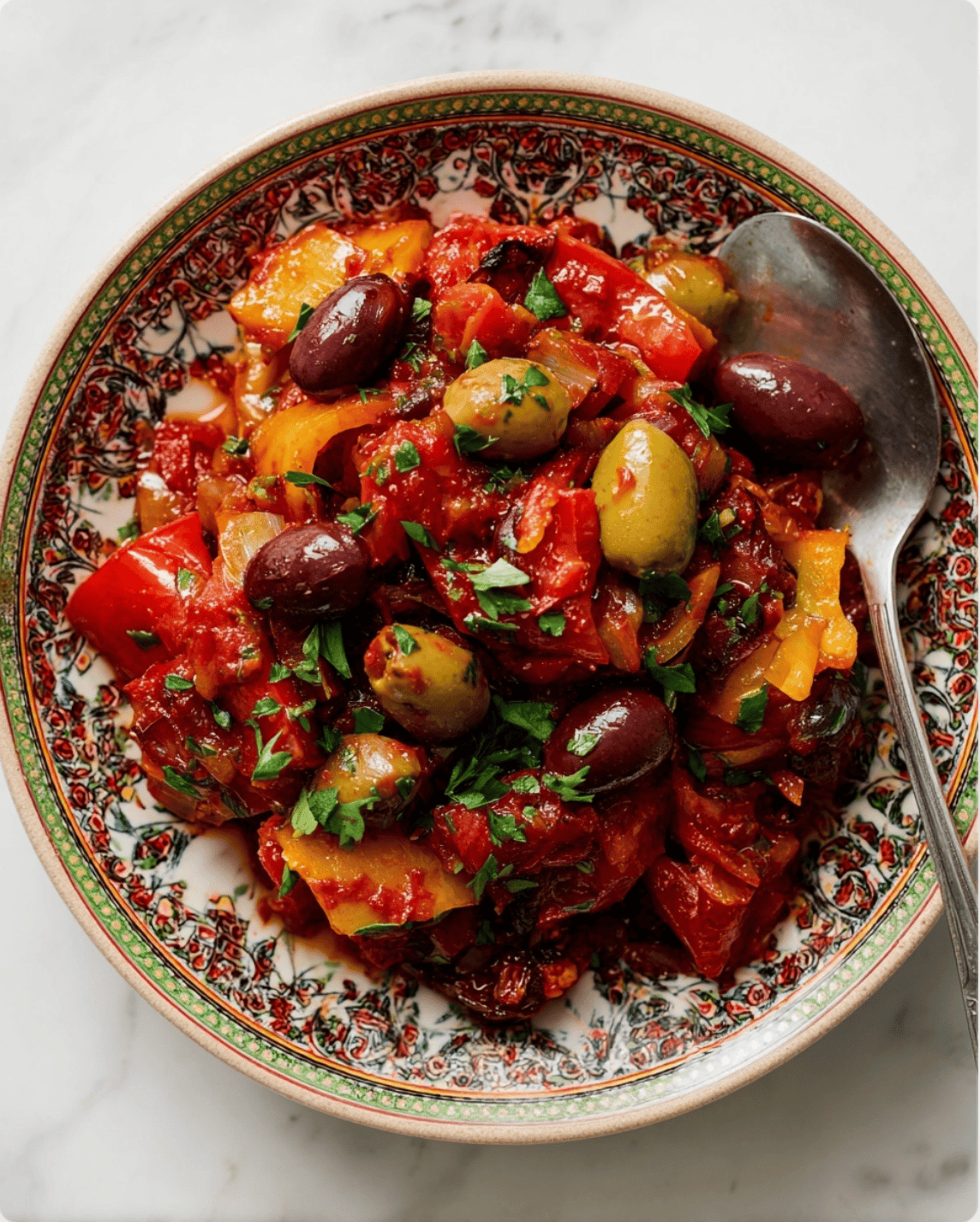
This vegan peperonata is soft, saucy, a little sweet, a little salty, and loaded with olives that make every bite more interesting.
Peperonata is one of those recipes I come back to because it does a lot with very little.
You start with peppers, onions and tomatoes.
Nothing groundbreaking.
Then you cook them slowly enough for the peppers to soften, the onions to turn sweet and the tomatoes to collapse into a thick, glossy coating around everything.
That is where it gets good.
I like using both red and yellow peppers because they give you slightly different sweetness and make the finished dish much more inviting.
Then I throw in a mixture of green and Kalamata olives right near the end.
They stay plump, salty and obvious rather than disappearing into the sauce.
A good handful of parsley finishes it.
And that’s really all it needs.
Warm, room temperature or straight from the fridge the next day, this is one of those vegetable dishes that quietly gets better the longer it sits.
What Is Peperonata?
Peperonata is a traditional Italian dish built around slowly cooked bell peppers.
Different regions and families make it differently.
Some versions are very simple with just peppers, onions and olive oil.
Others add tomatoes, garlic, vinegar, herbs or olives.
I prefer a tomato-rich version because the sauce clings beautifully to the softened peppers instead of leaving them oily.
The finished dish should still be chunky.
This is not pepper sauce.
You want to be able to see the pieces of pepper, onion and whole olives in every spoonful.
Ingredients
This serves 4 to 6 as a side dish.
For the peperonata
- 3 large red bell peppers
- 2 large yellow bell peppers
- 1 large brown or yellow onion
- 3 tablespoons extra-virgin olive oil
- 4 garlic cloves, thinly sliced
- 1 x 400g tin chopped tomatoes
- 2 tablespoons tomato paste
- ½ teaspoon dried oregano
- ¼ teaspoon chilli flakes, optional
- 1 teaspoon fine sea salt, plus more to taste
- ½ teaspoon freshly ground black pepper
- 80g green olives
- 80g Kalamata olives
- 1 tablespoon red wine vinegar
- Small handful fresh flat-leaf parsley, roughly chopped
Prep the Peppers
The peppers should stay fairly chunky.
That matters because they soften considerably as they cook.
If you slice them paper-thin at the start, they can almost disappear into the tomatoes by the end.
- Remove the stems and seeds from the peppers.
- Cut them into broad strips.
- Cut a few of the wider strips into chunky pieces.
- Slice the onion into medium-thick strips.
I like a mixture of shapes rather than making everything perfectly uniform.
It gives the finished peperonata that slightly rustic feel it should have.
Start With the Onions
Use a wide frying pan, sauté pan or shallow casserole.
You want enough surface area for the vegetables to cook down rather than steam in a deep pile.
- Heat the olive oil over medium heat.
- Add the sliced onion.
- Sprinkle over a small pinch of salt.
- Cook for 6 to 8 minutes.
- Stir occasionally.
The onions should soften and begin turning translucent.
You don’t need them deeply browned.
This dish is about sweetness rather than caramelised onion flavour.
Add the Peppers
Once the onion is soft, add all of the peppers.
It will look like far too much for the pan at first.
Give it a few minutes.
Peppers collapse surprisingly quickly once they start cooking.
- Add the red and yellow peppers.
- Toss them through the onions and olive oil.
- Cook for 8 to 10 minutes over medium heat.
- Stir every couple of minutes.
You want the peppers to begin softening while still holding their shape.
A few darker edges are welcome.
They add flavour and keep the whole thing from tasting too gently stewed.
Add the Garlic and Tomato
Once the peppers have started softening, add the garlic.
- Stir in the sliced garlic.
- Cook for about 1 minute.
- Add the tomato paste.
- Stir and cook for another 1 to 2 minutes.
Cooking the tomato paste briefly takes away its raw edge.
It also gives the sauce that deeper brick-red colour.
Now add the tomatoes.
- Pour in the chopped tomatoes.
- Add the oregano.
- Add the chilli flakes, if using.
- Add the salt and black pepper.
- Stir everything together.
Let the Peperonata Cook Down
This is where patience pays off.
The vegetables need time to soften and the tomato needs time to reduce.
- Lower the heat to medium-low.
- Cook uncovered for 20 to 25 minutes.
- Stir every few minutes.
The peppers should become tender and glossy.
The onions should almost melt into the tomato.
And the sauce should reduce until it clings to the vegetables rather than sitting as a thin liquid underneath them.
If the pan gets dry before the peppers are tender, add a small splash of water.
Not much.
A few tablespoons is usually enough.
Add the Mixed Olives
The olives go in near the end.
That way they warm through without becoming overly soft.
- Add the green olives.
- Add the Kalamata olives.
- Stir gently.
- Cook for another 5 minutes.
I leave the olives whole.
They look better, they keep their texture, and you get proper salty bites rather than little chopped pieces disappearing into the tomatoes.
Use pitted olives unless you enjoy giving everyone at the table a dental obstacle course.
Finish With Red Wine Vinegar
The little splash of vinegar at the end makes a bigger difference than you might expect.
The peppers and onions are naturally sweet.
The tomatoes are sweet too once they’ve cooked down.
A touch of acidity keeps everything balanced.
- Remove the pan from the heat.
- Stir in the red wine vinegar.
- Taste for salt and black pepper.
- Fold through most of the chopped parsley.
- Leave the peperonata to sit for 5 to 10 minutes.
That short rest gives the sauce a chance to settle around the vegetables.
Then scatter the remaining parsley over the top before serving.
What the Finished Peperonata Should Be Like
This should not be watery.
It should not be completely dry either.
Think soft peppers coated in thick tomato juices with glossy olive oil around the edges.
The peppers should hold their shape when you spoon them out.
The tomatoes should have broken down enough that there are no obvious watery chunks.
The olives stay whole.
And the onions should be soft enough that they almost disappear between everything else.
That combination is what gives peperonata its lovely, slightly jammy texture.
What to Serve With Peperonata
There are a ridiculous number of ways to eat this.
Warm crusty bread is the obvious one.
Spoon the peperonata onto slices of toasted sourdough and let the bread soak up the tomato and olive oil.
Very hard to improve on.
It also works well with:
- Grilled or toasted ciabatta
- Polenta
- Pasta
- Roasted potatoes
- White beans
- Grilled tofu
- Vegan sausages
- Rice
- A simple green salad
You can also pile it onto bruschetta for an easy starter.
And if you’ve got leftovers, tuck them into a sandwich the next day.
That might actually be my favourite use for it.
Tips for Better Peperonata
Don’t rush the cooking.
The peppers need time to become properly tender.
If you cook everything on high heat for ten minutes, you’ll have sautéed peppers, not peperonata.
Keep the peppers chunky.
They shrink quite a lot.
Starting with larger pieces gives you a much better final texture.
Use good olives.
They are not just decoration.
They bring a lot of the salty, savoury character to the finished dish.
Add the vinegar at the end.
You want that little flash of acidity to stay noticeable.
Use enough olive oil.
Three tablespoons might sound generous, but peperonata needs it.
It gives the vegetables that characteristic glossy finish and carries the flavour of the garlic and herbs.
Q&A
Is peperonata served hot or cold?
Either.
I like it warm the first day and at room temperature after that.
It’s also very good chilled, especially in summer.
Can I make peperonata ahead?
Yes.
In fact, it’s one of those dishes that often tastes even better after a few hours.
The peppers sit in the tomato, olive oil and vinegar and the flavours become more settled.
Make it a day ahead if that makes life easier.
Can I use only red peppers?
Yes.
Red peppers will give you a slightly sweeter peperonata.
I like mixing red and yellow because you get a little more variation in flavour and texture.
Can I add capers?
You can.
A tablespoon of drained capers would work well with the olives.
I wouldn’t add much more than that because the dish can become overly salty quite quickly.
Can I leave out the olives?
Absolutely.
Traditional peperonata doesn’t always contain olives.
Without them, you’ll have a slightly sweeter and simpler version.
Is peperonata vegan?
Yes.
This version is completely vegan.
The base is just peppers, onions, tomatoes, olive oil, garlic, herbs and olives.
Can I use fresh tomatoes instead of canned?
Yes.
Use around 500g ripe fresh tomatoes, roughly chopped.
You may need to cook the peperonata a little longer because fresh tomatoes can release more water.
Why is my peperonata watery?
It probably just needs longer.
Keep the pan uncovered and let the tomato juices reduce over medium-low heat.
A wide pan helps enormously.
Storage
Let the peperonata cool completely before transferring it to an airtight container.
Keep it in the refrigerator for up to 4 days.
The flavours become stronger as it sits, so leftovers are genuinely something to look forward to.
You can reheat it gently in a saucepan.
Or don’t.
Let it come back towards room temperature and serve it exactly as it is.
I actually prefer it that way on day two.
Final Thoughts
Peperonata is not complicated food.
That is precisely why it is so good.
Sweet peppers.
Soft onions.
Garlic.
Tomatoes.
Good olive oil.
A handful of salty olives and enough parsley to freshen everything up.
Cook it slowly and let the vegetables do their thing.
Then put some bread nearby.
You’ll need it.